Wednesday, June 11, 2008

Chicago Fair Trade GlobalFest

Join Chicago Fair Trade to
Celebrate World Fair Trade at Globalfest

Saturday, June 21 featuring
Inti Raymi and De Hurricane band

Little Black Pearl
1060 E. 47th Street

7 pm - 11 pm
7pm-9pm: Fair Trade Market Place
8pm: Program Begins

Inti Raymi or “Festival of the Sun” is a musical group that has been promoting the music and culture of the Andes here in the Midwest since 1986. De Hurricane - Haling from the exotic isle of Dominica, Cleve “Hurricane” Jean Jacques has been a professional musician since he could remember. Hurricane’s musical career began at the tender age of fourteen, when he was performing as lead guitarist and vocalist for the Island’s leading band.

Tickets: $25 advance / $35 at the door
Ticket includes Hors d'oeuvres and one drink ticket.
Buy tickets and sponsorships at: www.chicagofairtrade.org

Chicago Fair Trade is growing the fair trade movement in the metro area. Through increasing consumer demand and retail suppliers, we contribute to sustaining communities around the world. Attend and support efforts to raise awareness of the need for trade justice.

Loyola University Chicago is one of nearly 60 member organizations of Chicago Fair Trade and a Trading for Justice Promoter sponsor of this event.

Monday, March 17, 2008

Delicious Peace: Hope on a Platter (or in your Cup)

Last week I attended an event which hosted a coffee cooperative delegation from Uganda. The name of the cooperative is Mirembe Kawomera, which means Delicious Peace. This is an especially inspiring and encouraging fair trade initiative. What makes it unusual is that it is an interfaith cooperative, gathering Jewish, Muslim, Protestant and Catholic Christian coffee farmers together to put aside their differences and share a livelihood towards peace and sustainability in their country. I was so struck by this local grassroots and transnational effort that combines economics with peacemaking (as E.F. Schumacher would say, "Economics as if People Mattered"). The cooperative's coffee is sold in the U.S. by California-based Thanksgiving Coffee.

The event featured four panelists representing each of the different faiths represented in the cooperative and a representative of Thanksgiving Coffee. They shared the vision and history of the project and discussed in real honest ways some of the challenges they face in the Fair Trade marketplace. For instance, while Thanksgiving Coffee has ordered more and more coffee from the cooperative in recent years (from one container in the first year in 2005 to three last year) they have been unable to sell a majority of the coffee from year to year. I asked a question inviting the panel to discuss the limitations of fair trade from the producer's perspective. One of the panelists indicated that fair trade was good when coffee prices are low because it provides a stable and higher price. However, when prices are high(er), as is the case now, it makes little difference since it provides a fixed price. In other words, not only is it constrained by market realities that influence consumption, it also does not adjust to market shifts in terms of pricing in order to indicate that Fair Trade is really a better deal. At the current point, he mentioned that the Fair Trade premium is only five cents. This was a refreshing moment to understand the benefits that that can exist through Fair Trade and the kinds of relationships that are possible. It was also a meaningful exchange on how Fair Trade can really be made fair in the eyes of the producer. Overall, I was just blown away by the hope-filled endeavors of this coffee cooperative which demonstrate our overriding potentials for understanding, human harmony and interdependence.

Tuesday, December 4, 2007

Comercio Casi Justo

So, it's been quite some time since I've made any posts. Awhile ago I said I would make some comments about some of the growing pains of the fair trade movement.

In the last few years, as the fastest-growing niche in the coffee market has continued to expand, the ways that fair trade coffee products are available to consumers is diversifying. Fair trade coffee is not only available from Starbucks (just one blend called Cafe Estima) and Dunkin Donuts (its espresso beverages are made with fair trade beans) but also in the grocery aisle where you'll find a handful of fair trade coffees mixed in with the more conventional brands and blends. For instance, Target now has several fair trade coffees available from its Archer Farms brand. Millstone, owned by Procter & Gamble, sells a fair trade coffee rarely available at larger grocery chains and usually as long as customers have asked for fair trade. It's called Mountain Moonlight. You might also encounter a variety of coffees that appear to be somewhere in between fair trade and organic, like the shade grown and bird-friendly coffees sold by Seattle's Best and other brands. Then there's the boutique coffee places like Intelligentsia (now, having opted out of the fair trade certification regime, is marking many of its coffees "direct trade" having created its own label through a process they claim is better than fair trade but that does not include third-party verification). Beyond that, you also have the more politically oriented coffee or fringe retailers like Just Coffee or Cooperative Coffees that see themselves as more movement-based rather than market driven. These guys may not use the Transfair certification model (complaining that it's become too institutionalized) and they promote themselves as 100% fair trade as compared to the part-time or maybe they'd say half-assed fair traders like Starbucks and others.

All of this says that there's definitely a market for fair trade coffee and a growing one. But things are seeming a little out of whack; the movement is spliting and its getting harder for the consumer to know if a company's commitment to fair trade is authentic or just another aspect of the trend of the corporate greenwashing we see so much of these days. Depending on the way you look at it, fortunately or unfortunately, it is getting more and more popular for companies to want to promote or see themselves as socially responsible and environmentally sustainable. And the fair trade/green movement should receive a lot of credit for pushing things in this direction. But the public relations guise of fair trade assigned to a company like Philip Morris doesn't really cancel out the corporation's misdeeds and other dirty investments - just out of offering one fair trade blend among all of it other coffees and products. Let's be honest, doesn't it really mean that the company is extending its product line to make more of a profit from a new set of consumer preferences? If so, what about the fair traders who wish to see an economy as if people matter? Under what arrangements is it happening this way? Is it even happening? Well, I guess so. The more fair trade coffee being sold, no matter who is selling it, does mean, or theoretically should mean, that more producers are getting more decent and stable prices for their coffee. But it also seems to reveal that when you buy the Millstone brand you are affirming a market-based, consumer-driven arrangement that is more about making ethical consumers feel better about themselves than about making life marginally better for coffee producers. What are the implications of market-driven forms of social justice being played out through the now viable, somewhat mainstream approach of fair trade? What's that you say? I thought fair trade was supposed to be more concerned with the reality of the poor producer...?

Sunday, August 19, 2007

100% Fair Traders vs. Part-Time Fair Traders

There's been a lot of discussion lately over the authenticity of a roaster's commitments to fair trade when only some of their product is available as fair trade. Catholic Relief Services keeps a decent list of the 100% fair trade enterprises that it works with. I'll admit being puzzled as to why CRS is not a part of the Equal Exchange Interfaith Coffee Program but this is a fairly comprehensive list of the 100% fair traders in the U.S.

I'll say more another time about trends and arguments in the fair trade coffee certification debate as certain roasters either defect from or simply opt out of the Transfair system by setting up their own, often termed "direct trade," certification standard (i.e. Starbucks, Intelligentsia, Just Coffee). These changes represent a growing split in the fair trade coffee movement.

Easy Ways to Get Fair Trade Coffee at the Office

As interest in fair trade has grown--mainly through attention to fair trade coffee--consumers are looking for and demanding more convenient ways to purchase fair trade.

Here are some ways that I know of that you can order pre-measured 12-cup brew packages for the office:

From the Equal Exchange Interfaith Coffee Program (Equal Exchange is one of those outstanding fair trade pioneers and a 100% fair trade business). Try their pillow pack coffees.

My dad told me about a local roaster in his area that provides similarly prepared packets of a fair trade Guatemalan coffee. The only drawback with this company is that they also throw in industrial size coffee filters which were too big for my office coffee maker. We started cutting the filters down to size, but eventually it sort of cancelled out the added convenience of having the ready-made pouches for making a quick pot in the a.m. They declined to stop sending the filters since this is the way the boxes are prepared for most of their clients. Check out Ferris Coffee & Nut based in Grand Rapids, MI. Scroll down to their fair trade coffees. When you order, make a request for the 12-cup coffee packets.

Of course, convenience can often mean more waste. And in this case, it probably does, because of the additional packaging required for making individual pouches. Still, if the added convenience provides a way for you to convince folks in your office to make the shift to supporting fair trade--give it a try. After all, let's face it, not everyone knows how to make a good pot of coffee.

Later on, once the commitment to fair trade has taken hold in your office find a local roaster and begin enjoying the ritual of scooping out the appropriate amount to be brewed (1 to 2 teaspoons for every six ounces of water) from a pound of their fair trade coffee.

Monday, July 30, 2007

UMCOR Project News from Marengo, IL

My wife's family attends a Methodist church in Marengo, IL. Awhile ago, her dad introduced me to a guy who was in the process of setting up a fair trade coffee ordering co-op for their congregation. His name is Brian Standley. I asked Brian to send along an update on his and others efforts within their church to promote fair trade (see below). Brian said that if anyone is interested in learning more about doing something like this in their church he would be happy to share more with them. Just post a comment on the blog and I'll put you in touch with him.

I will make an effort to share fair trade success stories like this and feature other interesting trade justice initiatives on the blog from time to time.

Here is what Brian tells us about the UMCOR Fair Trade Co-op at Marengo Methodist:

We started the Co-Op soon after Halloween. Our Wesley Fellowship Group did a Halloween Outreach for the neighborhood trick-or-treaters where we gave out free coffee and hot chocolate. I volunteered to get the coffee and hot chocolate. I had heard about the United Methodist Committee on Relief (UMCOR) Coffee Project some time ago and was always curious about how it worked. Now I had an excuse to try it out. Both the coffee and hot chocolate were reasonably priced and (of course) delicious. We had many happy kids and parents that night (it was kinda cold). Afterwards, I had some extra coffee left over, so I hit on the idea of giving it away to the congregation to see if there was interest in beginning a co-op. I seperated
it into 1/2 pound bags, made my pitch during church, and gave it away on a Sunday in November 2006. Some people were a little shocked that I wasn't charging anything for the samples. Then I stood back and waited for the response. Within a few weeks, people started asking me when there was going to be more coffee. With the holidays approaching, I decided to wait until January to make our first order.

On January 14th, I put an order form in the worship bulletin offering one choice of regular coffee and one choice of decaf (both whole bean or ground). I also let people know that tea and hot chocolate was available as well. The response was better than I had anticipated. Sixteen people made orders that day and since then we've had three more orders totaling over $1,100 of coffee, tea, and hot chocolate. The church is also now buying the coffee for fellowship hour from the UMCOR Coffee Project.

I've made some tweeks in the process since that first order, but it basically remains the same. About every six weeks, I choose one regular and one decaf coffee and create an order form. I leave the order form by a container in the lobby for people to place their orders any time during the six week period. The week orders are due, I put a reminder in the bulletin and I set up a "Taste of Justice" stand-up display in front to the ordering container to jog people's memories. The coffee normally comes in a week to ten days later and we hand it out after worship services.

Lately I've been putting notes and cards in peoples bags reminding them of the next ordering date and encouraging them to share their coffee with their friends and neighbors that don't go to our church. With our next order I will be putting in stories about the farmers they are helping to give them some connection to their buying choices. It's my hope that folks will begin
to see this not just a way to get a great cup of coffee but also begin to see the impact of all their purchases and begin asking, "what would Jesus buy?"

As we approach the one year anniversary of the co-op in November, I'm going to try to have a Fair Trade Sunday to re-engage folks in the purpose (and the people) behind the coffee. The experience has truly been a blessing in my life. I spent some time within the coffee growing regions of Guatemala, so I can see in my mind's eye the faces of those we are helping. It's such a simple thing: an honest day's wage for an honest day's work for a product we can't even grow in this country (with all due respect to Kona). Who could argue with that?

The UMCOR Coffee Project (along with seven other denominational efforts) is part of the larger Interfaith Coffee Program administered by Equal Exchange.

A Coffee Tale


My friend Ted Erski teaches in the earth science department at McHenry County Community College in Crystal Lake, IL. A coffeeholic and geographer, he has developed an amazing course called the Geography of Coffee. He also finished his first self-published novel called Salavandra: A Coffee Tale. Ted did several readings from the book in area cafes that support fair trade. I asked him to write up a synopsis of the book and his interests for the blog. You can order the book from Amazon.com or download a free audio copy.

"My current professional interests lie in globalization, social development and the interplay amongst economics, politics and the environment. I'm most interested in how coffee, an ostensibly simple commodity, connects consumers in the developed world with producers in the developing world. To this end I created a course called “The Geography of Coffee.” The nuanced, politically and economically charged character of this global commodity also inspired my first novel, Salavandra: A Coffee Tale. The story is about a revolution on a coffee-producing island. More significantly, however, it offers readers a critique of US trade policy, globalization and international labor conditions.

I use the novel in my geography classes. Here are three questions I ask my students about the text:

1. Compare and contrast communication infrastructure and access to information and technology between the developed and developing world as represented in the first three chapters of Salavandra. What might the term "the digital divide" mean in the context of Salavandra's first three chapters?

2. In Chapter four, what symbolizes the conflicting view about the value of natural resources between the developed and developing world?
Thinking about Chapters four through six, describe how Salavandra illustrates that access to information can level the playing field for advocates of working people in the developing world.

3. Thinking about chapters seven through nine, how does Salavandra illustrate that politics and business often work together, and what is often beneficial to consumers in the developed world can actually harm producers in the developing world?"


Ted became an individual member of Chicago Fair Trade (www.chicagofairtrade.org) in May.

Thursday, May 31, 2007

Take Action: Oppose Free Trade Agreements & Fast Track Renewal


I just returned from a delegation to El Salvador about a week ago. U.S. influence, through CAFTA and other means, over El Salvador's now dolarized economy has had disastrous effects on the poor of this small, densely populated Central American country (about the size of Massachusetts packed with around 7 million people). Many of the producers and activists our group had the opportunity to speak with stated that El Salvador no longer has any viable crops that trade well on the world market. Coffee and other commodities are no longer the strong exports they once were due to changes in market prices & oversupply problems in the global economy, in addition to agricultural subsidies awarded to farmers in the U.S. and Europe that aggravate already pronounced trade imbalances. One mantra we heard repeated time after time is that currently El Salvador's biggest export is people. According to an investigation performed by the Jesuit University of Central America (the UCA), 700 people (finding no options for enough work to feed their families) leave El Salvador headed for the United States every day. Many end up stuck in Guatemala or Mexico along the way. Last year 14,000 Salvadorans were deported by the U.S. government. Deported individuals are often viewed as outcasts and sometimes criminals in the communities they return to. So, the primary contribution to the Salvadoran economy now (like the experience of Mexico/NAFTA) -- supporting many poor families in El Salvador at varying degrees -- is the arrival of remittances from family members in the U.S.

Remittances have created a new system of dependence on family incomes now being earned in the U.S. -- income that is not able to be gathered or generated by activities in the country due to lack of jobs and inappropriate/insufficient economic policies, programs or infrastructure, leaving many people in the society idle. The main message from everyone we talked to is that migration is destroying the family in El Salvador and beyond that the entire country because of the profoundly negative consequences for the economy. In general, there is a lack of response by the government because of the powerful dynamic of remittances from the U.S. along with other economic directions taken as a requirement of the free trade agreement.

Global Exchange and other groups have launched campaigns in oppposition to the country-specific free trade agreements currently being debated by our Congress aimed at the Peruvian, Colombian, South Korean economies. The U.S. should change its trade policy in order to avoid further complications that stem from a sinfully unfair global trading system that pursues a preferential option for the rich.

The same action alert also calls on Congress not to renew the Bush administration's fast track trade authority. Furthermore, Global Exchange has most recently called for a moratorium on free trade agreements with hopes to force our lawmakers and politicians to revise or remake our trade policy according to fair trade standards and specifications.

Thursday, May 3, 2007

Radio Interview: Live From the Heartland this Saturday, May 5

So, in case you haven't noticed by now I'm from Chicago. And this Saturday, May 5, I'll be on WLUW's (88.7 FM) Live From the Heartland at 9 a.m. It's broadcast from the Heartland Cafe in Rogers Park, practically an institution for progressive causes in the city for many years. I'll be talking about the fair trade movement and also have a chance to promote Chicago Fair Trade's World Fair Trade Day event on May 12 (see posting below from 5/1). The interview will likely address some of the differences between "Fair Trade" and "Direct Trade," a new trend among coffee roasters and retailers (i.e., Intelligentsia, Whole Foods, Starbucks). Hopefully, we'll get into some suggestions of ways people can take action to promote trade justice as well. Listen in.

Wednesday, May 2, 2007

Coffee Cultivation & Commodity Environments


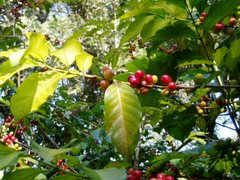
According to “traditional” methods, coffee is grown under a canopy of fruit and hardwood trees that provide a cover of mixed shade (WRI 1998-99, TED 2000). Under ideal conditions, this agro-ecosystem of shade-grown coffee can sustain a large diversity of bird species and small mammals (TED 2000). The agricultural habitat of forested coffee groves involves a small-scale production scheme that provides subsistence opportunities and addresses natural resource conservation goals with the sustainable harvest of shade trees for fuel and nutritional needs. This is in contrast to the dominant, higher-yield production method, which often involves removing forest to plant a monoculture crop grown in full sun. This method, usually referred to as “sun-farming” or “technified” cultivation, requires that fertilizers, dangerous pesticides and herbicides be applied often and has become the preferred approach on large coffee estates and plantations. Sun-farming practices have contributed to coffee becoming “the second-most heavily pesticide-sprayed product in the world (after cotton)” (Cycon 2001). Twenty percent of Guatemala’s coffee area is under technified production, compared with 40 percent in Costa Rica, 69 percent in Colombia, 17 percent in Mexico and 8 percent in El Salvador (Sorby 2002).

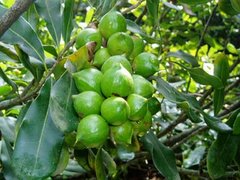
On most of Guatemala’s large coffee estates, varieties of high-quality Arabica are grown and harvested on highly managed shaded monoculture plantations, a modernized agriculture, high-density production scenario that requires chemical application, different from the often diversified plots of small-scale traditional coffee farming. The most common shade tree in Guatemala is gravilea (Australian oak), which tolerates heavy pruning for firewood; also, amate admired for the compostable quality of its broad leaves, as well as native trees like cuxin. Other trees common to a rustic, polyculture coffee shade forest include banana, avocado, and citrus trees such as lemon and orange. More and more, macadamia, a nut tree known for its environmental benefits, is suggested as a potential shade tree for Guatemalan coffee, and as a secondary or replacement cash crop. Even growing flowers among coffee is an increasingly common practice with the advent of organic production.